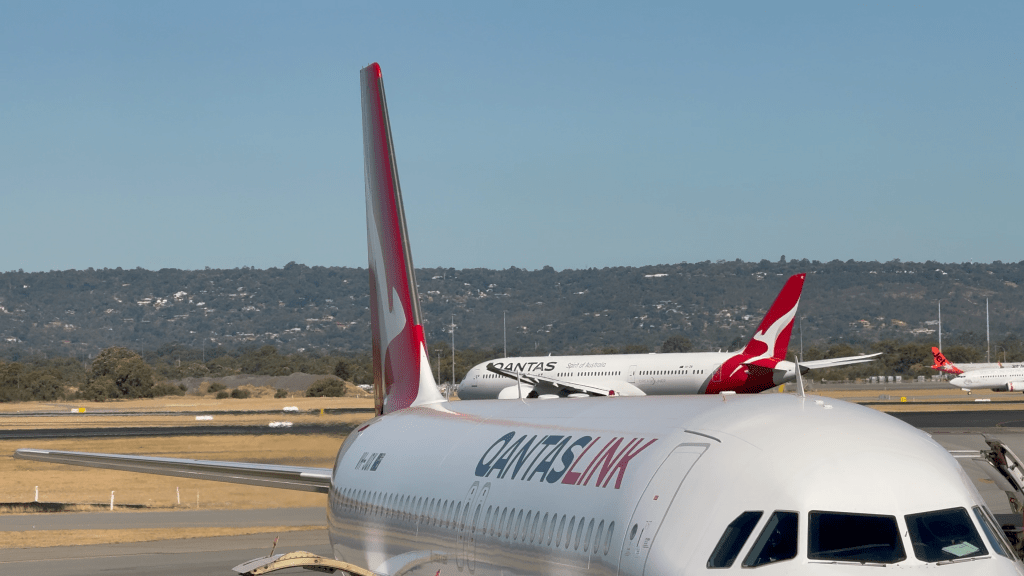
(This article has been reviewed by AI, some sentences may present abnormal)
I was initially scheduled to fly with Jetstar for this segment; however, due to a flight delay in Bangkok, I was unable to connect to this flight. A notable advantage of flying with Jetstar is its association with the Qantas subsidiary, which has increasingly strengthened as Qantas has begun integrating their frequent flyer program into the Jetstar network.
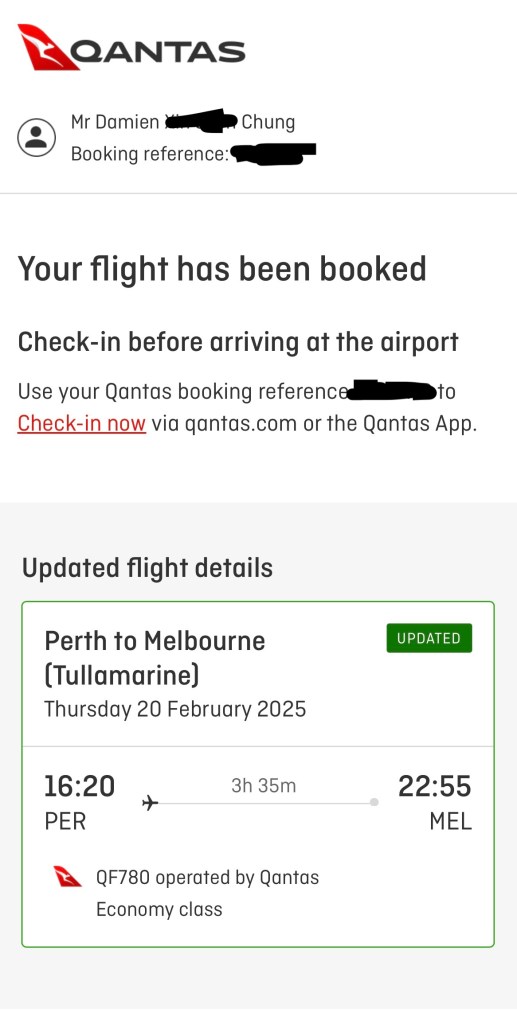
I arrived in Perth at 8:00 AM and received an email notification at 8:30 AM; however, I was unaware of this as I assumed ground staff would assist me in rebooking my flight. After attempting to locate the Jetstar domestic check-in desk, which is situated in a different terminal with minimal information regarding terminal assignments, I followed the signs to “domestic check-in,” leading me to Terminal 2. While I did find the Jetstar sign, there were very few personnel present, and none of them were affiliated with Jetstar. There were ground staff from another airline, so I inquired about Jetstar’s availability, and they informed me that they were uncertain when Jetstar staff would arrive, recommending that I contact them directly.
Upon reaching the Jetstar call center, I was informed that I had been rebooked onto a Qantas flight, which left me quite perplexed. I subsequently checked my email and discovered a message from Qantas confirming this change. The flight was scheduled to depart later than anticipated, at 4:20 PM, and was expected to arrive shortly before 11:00 PM. I attempted to secure an earlier flight, but Qantas stated that I would need to pay a fare difference, while Jetstar maintained that the flight they had provided was the earliest available.
It is my belief that Jetstar should have arranged for staff to meet my flight, given their awareness of passengers transiting and missing connecting flights due to delays. The presence of personnel to inform us of the circumstances would have significantly alleviated the confusion and saved me from navigating the airport in an attempt to ascertain the situation, particularly as Qantas operates from a terminal located on the opposite side of the airport. Additionally, Jetstar could have sent a follow-up email to ensure that the Qantas confirmation was received, considering that the two airlines operate separately and communication from my original airline was imperative.
CHECK IN
Qantas operates from Terminals 3 and 4, with Terminal 3 serving international flights and Terminal 4 handling domestic flights. The airport is equipped with numerous self-check-in kiosks, and there are usually staff members available to assist passengers. However, during my visit to the airport at approximately 2:30 PM, I found no staff present at the kiosks. Fortunately, there were a few staff members at the service desk who were able to assist me.
As my flight was scheduled to depart later in the day, I was informed that I could only check in six hours prior to departure. I utilized the time to attend to other matters and returned when I was eligible to check in. It is possible I did not articulate my intentions clearly, as the staff member informed me that I could not drop off my luggage until I had completed the check-in process. I had intended to do so. Ultimately, the staff member indicated that she would make an effort to check me in, after which I would be able to utilize the self-service bag drop. None of the staff members were impolite or dismissive; however, a few conveyed an impression of reluctance in their demeanor.
BOARDING
The airline operates with six boarding groups, where groups 1-2 are designated for business class passengers and higher-tier frequent flyer members of the OneWorld alliance, while groups 3-6 are called in sequential order from the rear to the front of the cabin.
The cabin crew exhibited a friendly demeanor throughout the boarding process. As I was seated in the last row, I took the opportunity to inquire with the crew member stationed there about the availability of vegetarian meals on board. He confirmed that such options were indeed available.
Shortly thereafter, a lady took her seat by the window, at which point the cabin crew provided her with a bottle of water. I am uncertain as to why she received this preferential treatment, as it is possible she may have been a deadheading crew member. However, it was noted that aside from the lady occupying the seat in front of her, none of the other passengers received similar personalized attention.
FLIGHT
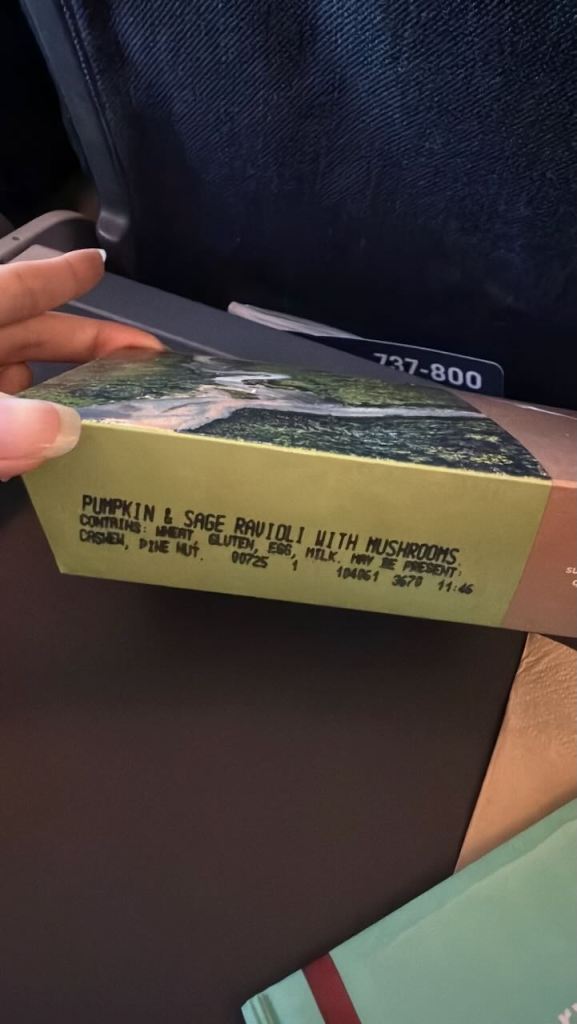

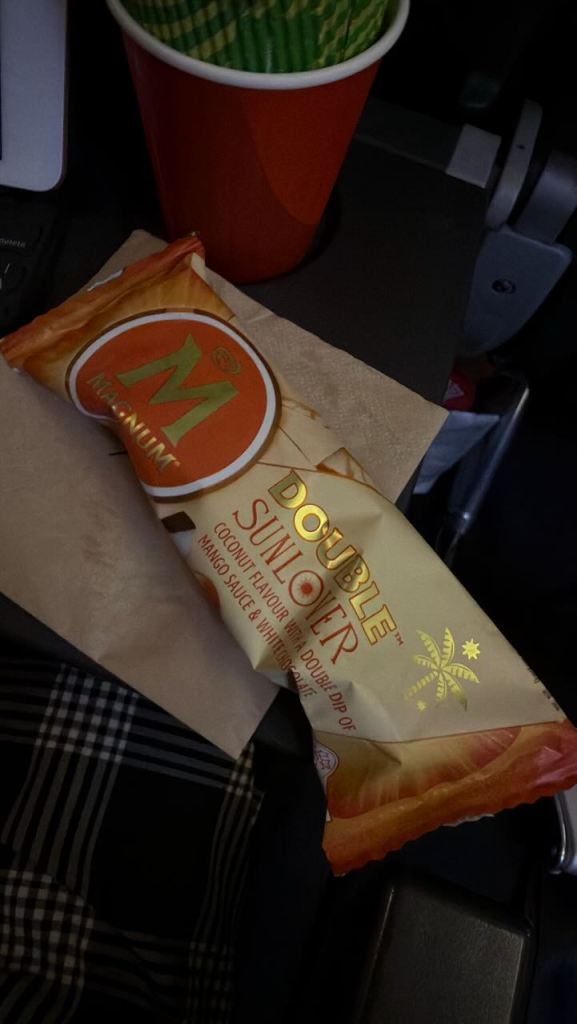
We departed more or less on time; I was quite fatigued, so I inadvertently fell asleep. Approximately one hour after the flight’s departure, the meal service finally reached our row at 17:45. An announcement was made regarding the available meals onboard, which consisted of lamb and beef. I found myself somewhat perplexed as to which option, if any, was vegetarian, as neither appeared to be suitable for such a diet. The crew recalled my inquiry and retrieved a Pumpkin & Sage Ravioli with Mushroom from the bottom of the cart. I am curious as to why this option is not announced; it seems that passengers may need to request it if they have special dietary requirements. I find it somewhat peculiar that it resembles a secret menu. The food was satisfactory, and I was not particularly hungry at that moment, having consumed a substantial meal during lunch in the city. Prior to our descent, we were also provided with a Magnum ice cream, which was an unexpected yet delightful addition for a flight, especially one of this duration. I would assert that, considering the provisions offered during the flight, it was quite commendable, and I would likely prefer Qantas over Jetstar or other carriers if the price differential is not significant.

Each seat was equipped with an in-flight entertainment (IFE) system; however, the selection of movies was neither particularly impressive nor did it feature many recent releases. The television series section was even less satisfactory, offering only a limited number of episodes per series, which may not provide sufficient entertainment for an extended period. It remains uncertain whether the selection differs on long-haul aircraft. The in-flight map is static, yet there is a notable enhancement in the system: additional information regarding flight speed, altitude, and distance is available in a separate section adjacent to the static map. This is the first instance I have encountered such a feature, which renders the static map more bearable, although it still does not compare favorably to a modern interactive in-flight map system.

If you are not inclined towards the IFE (In-Flight Entertainment) system, it is worth noting that complimentary Wi-Fi is provided on board, available on select flights. The aircraft I was on indeed offered this service, as evidenced by the individual seated next to me who utilized her laptop for streaming movies after takeoff. Initially, I presumed that these films were pre-downloaded; however, I soon realized that was not the case, as the internet connection faltered midway through the flight, interrupting her viewing experience.
The seating arrangement afforded minimal legroom, particularly in the middle seats, resulting in an uncomfortable experience. I was situated in the last row, which I believe contributed to the limited reclining capability of my seat. This design flaw caused my seat to revert to its upright position unless I exerted my body weight to maintain its recline. Overall, the ride was not particularly pleasant, and I would have been dissatisfied had I paid the full fare. While the seats themselves are modern and generally comfortable in terms of cushioning, they lack thoughtful design elements. In contrast, my recent experience with Jetstar on their A321neo showcased a more user-friendly tray table conducive to placing devices and cups without the need to lower the entire tray.
During the landing phase, the cabin lights were not dimmed, resulting in the lights remaining at near-full brightness throughout descent. It is my understanding that the cabin lights can be adjusted to a dim setting accompanied by ambient light, as this procedure was observed during the cruise phase. I am curious as to whether this practice aligns with aviation regulatory standards and if it constitutes standard operating procedure (SOP) for Qantas. Such inquiries arise from my pilot training, which emphasized the importance of allowing sufficient time for passengers to transition their eyesight to darkness, thereby mitigating any unnecessary light sources that could compromise night vision. Moreover, it is widely recognized that in the event of an emergency, the capacity to evacuate swiftly and effectively in low-light conditions is paramount to reducing the risk of injury. This practice raises significant safety concerns, regardless of the airline’s safety record. Accidents can occur without warning; thus, we have established numerous layers of protection over the decades. I am eager to learn who is responsible for this decision, as it appears not to prioritize safety.
CONCLUSION

I believe that Qantas is providing commendable offerings, particularly in terms of catering. I cannot evaluate the quality of the seating until I have the opportunity to experience other standard seats that do not have walls obstructing the reclining function. Furthermore, while the in-flight entertainment (IFE) system presents a decent array of options, the selection of television series is notably lacking, which is unsatisfactory. The availability of in-flight Wi-Fi compensates for the limited entertainment choices, provided that the aircraft in question is equipped with this service.
In general, I find myself content with the experience thus far, especially when considering that my original Jetstar flight would have been considerably less comfortable, lacking entertainment, Wi-Fi, and catering services. My perspective is influenced by the transition from a low-cost carrier to a full-service airline while paying a fraction of what others would typically spend for similar flights.
The primary concern I have involves the absence of night safety measures concerning the cabin lighting. I am uncertain whether this practice aligns with aviation regulations in this region; however, many other airlines implement standard operating procedures that necessitate dimming or completely turning off the cabin lights. Whether this situation arises from oversight or is an established procedure, it is imperative that it is addressed promptly to prevent potential incidents where passengers may need to depend on those critical moments.

 PackJetRoam
Leave a comment